

By Jon Benjamin Originally Published at Jon Benjamin Philosophy of Art
The human need for shared meaning and community can be traced from prehistory to the present through sacred ritual art and practices. During the present century, many sacred rituals have been disrupted or abandoned, yet the desire for these practices continues to last in many fragmented and less enduring ways. This paper addresses this shift from enduring sacred rituals to short-lived digital practices. Ultimately, I will prove that our need for rituals persists, but the symbolic meaning attached to them no longer originates in the human imagination; rather, it is produced and transcoded by what Vilém Flusser refers to as the apparatus. By understanding this profound continuity between sacred and digital ritual art, we can better formulate approaches for navigating our digital future.
This paper will first establish a framework for the relationship between humans and sacred ritual art, drawing on the work of Warren Colman to illustrate how sacred sculpture ushered in symbolic thinking that led to shared, unifying experiences. Next, I will build upon this argument by analyzing the profound and enduring sacred masks and dances of the Bwa in Burkina Faso; whose ritual practices have provided cultural stability and a unifying experience for centuries. I will then trace the modern shift toward the virtual world by comparing the Bwa masks with the digital skins purchased by players of the video game Fortnite. I will engage with Byung-Chul Han’s critique in The Disappearance of Rituals, which suggests digital commodities are ineffectively displacing sacred art. I counter this with Ken Hillis’ Online a Lot of the Time, to demonstrate how contemporary online communities are creating new digital rituals to develop meaning and to build community. Finally, I will argue how Vilém Flusser’s concept of the Apparatus is the true source of destabilization in society, proving how digital rituals are merely symptoms of a broader modern condition that has co-opted symbolic meaning and ritual to perpetuate the neoliberal program.
To understand the origins of ritual, this paper briefly analyses the 40,000-year-old Lion Man sculpture to illustrate early human symbolic imagination (Figure 1). In his book Act and Image: The Emergence of Symbolic Imagination, Warren Colman proves how symbolic thinking first emerged from the human relationship with material objects. According to Colman, when humans attach meaning to an object and share the designation, the object becomes a symbol of the attached meaning. Symbols, such as language, jewelry or sculpture, provide an external form for an idea to attach to. One of the most enigmatic illustrations of this is found in the ivory-carved Lion Man from 40,000 BCE Germany, which is the oldest known example of figurative art (Figure 1). If a human creates an object that resembles both a lion and a man, this new object is a physical manifestation of the imagination. The realm of the imagination is the realm of images, dreams, and to some, a spirit world. If one can make concrete images from the abstract realm of the imagination, then abstract concepts such as religious beliefs can be solidified and shared among members of a community. Colman suggests that social interactions around a sacred object develop into rituals that only enhance the power of the sacred object within a community. He further maintains that sacred art objects such as the Lion Man may have served as a bridge between the spirit world and the physical world, eventually becoming Spirit incarnate (Colman, 202).

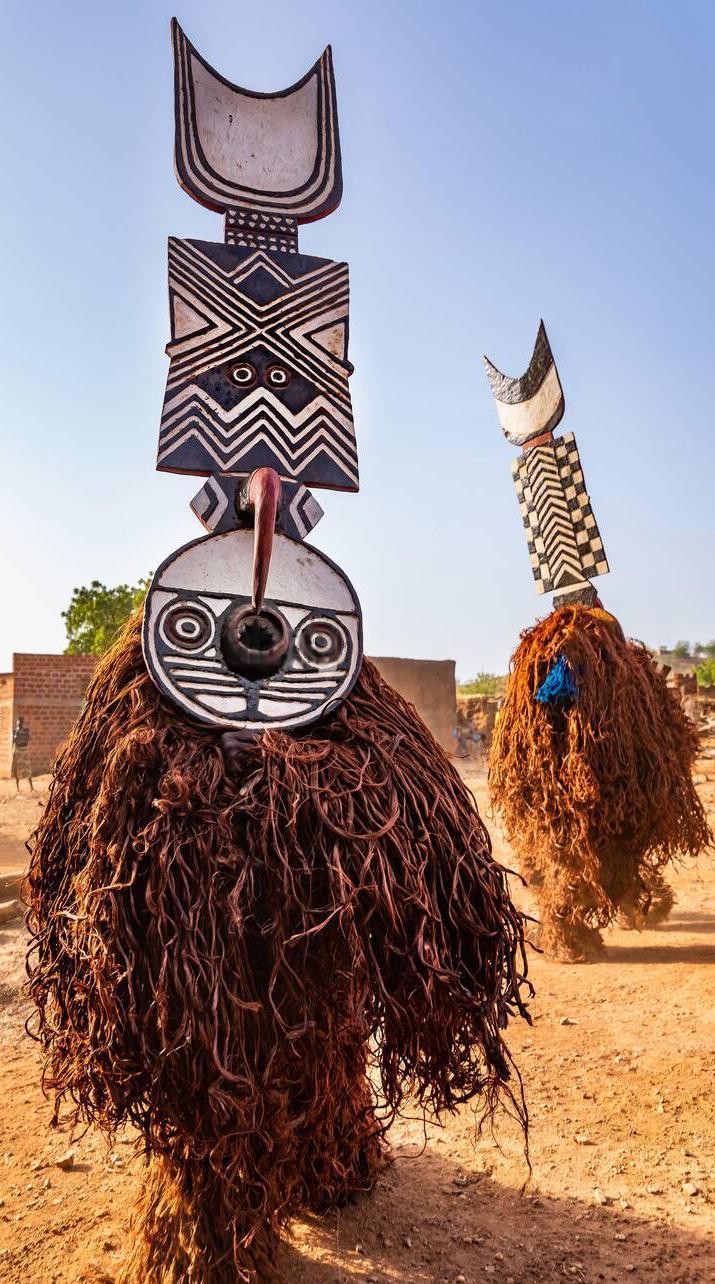
How does symbolic imagination relate to the development of sacred ritual art? To answer this question, I will now turn to the enduring sacred masks and ritual dances of the Bwa people of Burkina Faso. The Bwa have practiced ritual mask-making and dances for hundreds of generations (Roy, 40). Their sacred rituals include: initiations, funerals, village purification, upholding ethical laws, honoring ancestors, origin stories and petitions (Roy, 50-55). Masks are carved and painted with red, white and black geometric patterns that symbolically represent religious laws that have been given to the village priests from Spirits (See figures 2 and 3). Young men and women undergo several years of initiation rites, where they are taught the meaning of the symbols on the masks by the village elders. The carved and painted masks, encoded with symbolic meaning, provide a tactile representation of law, history, and spirituality that temporally binds the community. One commonly used symbol is black zigzag lines (see Figures 2 and 3) that represent the difficult paths traversed by the ancestors. As explained by a Bwa elder, “we must try the best we can to do as our ancestors did because they, after all, were successful” (Roy, 51). Each mask is meant to represent an animal spirit by combining different abstract animal forms such as: antelope, bush pig, hyena, serpent and hawk. Much like the chimera of the Lion Man sculpture, these masks are the Spirits incarnate that allow viewers and participants to experience the immaterial. The tactile symbol of the guardian Spirit strengthens the participant’s prayer for guidance along the path of their ancestors.

Like many religious practices, the ritual practices of the Bwa reach deep into the past and continue to endure. Unfortunately, many rituals have disappeared in modern societies. Byung-Chul Han, a contemporary philosopher, posits that neoliberal consumer culture traps individuals in a perpetual cycle of production and consumption, leading to disconnection and discontent. According to Han, we can resist this never-ending cycle by embracing symbols and ritualistic activities. It is through symbols that we silently share and connect with one another, as Han poetically describes “… rituals as symbolic techniques of making oneself at home in the world. …They are to time what a home is to space: they render time habitable” (Han, 2). Han’s main thesis is that modern society has lost its meaningful rituals, leading to existential anxiety and a lack of belonging. Han posits that rituals are symbolic acts that are diminished in our consumer-driven society, where everything is judged by its utility and productivity, stripping objects of their deeper symbolic meaning. This leads to a world that is “symbol-poor” (Han, 2). Han argues that symbolic perception stems from a shared, stable experience of the world. This stability is maintained by symbols used in rituals that are regularly practiced through generations. When one perceives a ritual symbol, such as a Bwa mask, they are reconnecting with a meaning that is already learned and shared by the community, drawing it from the past into the present, trusting it will endure into the future. This contrasts with the contemporary neoliberal obsession with the ‘new’. Rather than rendering art objects that reflect an enduring ritual, we create new replaceable objects to consume and discard, allowing for more, new objects to be consumed in a never-ending loop.
As enduring sacred rituals decline in modern society, are these practices replaced or do they disappear? I argue that rituals and symbolic imagination have been part of humanity before the Lion Man, and therefore, these practices are embedded into the human condition. I will argue that human’s continue to create new rituals in less enduring forms such as video games. Using Fortnite as a case study, I will attempt to prove how digital rituals can help humans feel at home in the world, but their conception and delivery is embedded in an apparatus that disrupts their stability.
Fortnite is a video game that possesses many of the requisites of sacred ritual. Fortnite is a Battle Royale, multiple player online video game that begins with 100 players parachuting onto an island (Figure 4), collecting weapons, and engaging with opposing teams in an attempt to be the last player standing. Each match lasts only 10-15 minutes, as a toxic storm shrinks the boundary of the island, eventually forcing the players to battle or die in the toxic cloud. In an age where everything is based on the ‘new’, Fortnite has proven to be an unusual example of longevity, as its player base continues to steadily grow since its inception in 2017. The video game’s success is likely owed to its seasonal use of new content and its astute alignment with popular culture. Each new season refreshes the theme of the island map and purchasable cosmetic “skins” to fit with current popular media. This seasonal aspect provides players with regular content changes that encourages them to return season after season. The most recent example of this commodification of popular media icons was the collaboration between Fortnite and the explosively popular South Korean animated film, K-pop Demon Hunters (Figure 4). Fans of the film raced to login to Fortnite and purchase the skin of their favorite character from the film. These seasonal changes are limited time events that effectively generate Fear of Missing Out (FOMO) incentivizing players to engage with the new content before it disappears. Both the seasonal events and the FOMO are illustrations of the neoliberal regimes’ attempt to keep players returning, which Han describes as an endless cycle of consumption and production. Fortnite skins are encoded with symbolic meaning from cultural icons that symbolize the player’s skill and interests. In a similar way the Bwa masks incorporate learned symbolic images that communities recognize, creating an unspoken unity among the tribe. Beyond this, both the Bwa ritual dancers and Fortnite players leave their primary identities behind and enter into a sacred space that suspends the rules of daily life for a constrained set of temporary rules.

These rules separate rituals and games from the seemingly chaotic real world. According to Johan Huizinga in his book Homo Ludens, “play…creates order, is order. Into an imperfect world and into the confusion of life it brings a temporary, a limited perfection” (Huizinga, 10). Both the game space and the ritual space illustrate a more perfect and simpler place, offering protection through limited, prescribed rules. Fortnite will regularly change the theme of the play space, but overall the gameplay and general look of the game is extremely consistent and predictable. The seasonal changes encourage players to re-engage with Fortnite, but once they enter the game for the new season, there is very little to learn and adapt to the prescribed framework, which provides the player with comfort and control. The Bwa dancers are adorned with costumes that are designed anew each season by local artists who follow a limited range of symbols and colors. Each Bwa ritual performance is scheduled for specific seasons and offers a temporary window into the Spiritual realm. In summary both games and rituals provide a predictable framework that establishes duration, but also provides flexibility and newness to keep the practice interesting.
In addition to predictable rules, digital spaces may also provide a substitute for Spiritual realms. The conscious goal of many religious rituals is to connect with entities from another realm, be it the land of the dead or with Spirits. Bwa dancers attempt to embody entities from the Spirit world to divine the future and connect with the past. How can a secular neoliberal culture embrace these transcendent experiences? The answer may lie in the telepresent nature of the internet. Humans can bi-locate or astral project themselves through web cams, chat rooms and video game avatars. Are these digital spaces acting as a substitute for traditional sacred spaces? Hillis would say they do, “Technology itself, for these individuals, approaches a material actualization of the ideal and performs sacred, even spiritual, operations similar to those once reserved for the sphere of religious practice” (Hillis, 64). Here Hillis argues that the digital realm is replicating many aspects once provided by the Spiritual realm. The play space in Fortnite is a three-dimensional virtual environment populated with lifelike fauna, buildings, roads, and infrastructure. Although presented on the player’s screen as a physical location, this environment, like the player avatars, exists only as digital code, lacking a real location, not unlike a spirit realm. This experience of meeting fellow players in a virtual realm may function in a similar way to participants in a sacred ritual who imagine a Spiritual realm.
In summary, sacred rituals and digital games ultimately provide a way for people to establish order in a chaotic world, by following rules, brushing against the transcendent, creating meaningful experiences that bind communities. I argue that despite the similarities, digital rituals do not fully supply humans with enough stabilizing duration to ease our anxieties caused by the neoliberal apparatus, which prevents these new rituals from fully performing their function.Digital rituals are weaker forms of sacred practices, but they are not the cause of ritual decline, nor do they contribute to the destabilization in neoliberal societies. I argue that it is the apparatus, rather than digital ritual practices, that is the root cause of ritual decline and societal destabilization. According to Vilém Flusser, a twenty-first century philosopher who suggests we are on the precipice of a “programmatic reality” which he defines as a world run by apparatuses composed of functionaries (Flusser, 24). Functionaries are humans who only wish to maintain the apparatus’s program. The apparatus, according to Flusser, is like a “black box”, with complexity so vast that individual functionaries cannot fully comprehend it (Flusser, 96). Since the apparatus is beyond comprehension, it operates on its own, treating the functionaries as cogs in a machine. For Flusser, bureaucracies, companies, computer programs and even cameras are all apparatuses that produce symbols which he refers to as technical images. “Traditional images are produced by men and technical images by apparatus” (Flusser, 95). Flusser would define the video game Fortnite as part of an apparatus. The game is programmed by functionaries who unknowingly follow the apparatuses program. Players are in turn, functionaries of functionaries, who collude with the program whose only purpose is for players to keep returning and consume. Technical images, according to Flusser, are post-historical, they are not created by humans but by the apparatus to present the illusion of objectivity (Flusser, 97). People have come to trust the photograph because it appears to be an objective replica. According to Flusser, the photograph is not objective, it is transcoded with layers of indecipherable information encoded by the apparatus. The Bwa ritual masks and dances, on the other hand, are created by humans and use traditional images to create imaginative scenes by encoding them with agreed upon meanings (Flusser, 93). When humans assign shared meaning to an object, it becomes a symbol from which regular interactions develop into a ritual. The ritual symbols are conceived by humans for humans, resulting in unifying cohesion, serving to benefit the group. Images that are transcoded by the apparatus are too complex for humans to decipher. Since the symbolic nature of technical images produced by the apparatus are undecipherable, we are unknowingly collaborating in our own enslavement.
If transcoded messages produced by the apparatus are too complex to fully decode and the apparatus itself escapes our understanding, how do we exist without losing ourselves under the absurd hegemony of the mindless apparatus? Flusser believes the solution involves a recognition of the apparatuses absurdity and intentionally disrupt the program. Only in sabotage can we catch a glimpse of the ‘real’ and gain a momentary sense of agency. Choosing to play the game in a way that was not intended allows for a brief moment of recognition of the absurdity of the program. This act of rebellion temporarily stops our cog from being played by the apparatus and the player may experience a brief glimpse of empowerment. In Fortnite players have devised a wide variety of ways to subvert the game by inserting their own constraints. The most common subversion is the refusal to shoot other players. A player can win by hiding and relying on the toxic cloud to kill the other players (Waldron). Another popular subversion is the hosting of fashion shows, where players will agree to meet at a designated location on the map and conduct a private fashion show (rFortniteFashion). Finally, many players have simply provided a free taxi service by offering other players rides around the map (Garst). By accepting the absurd and playing the game as it wasn’t intended, we can become a player in the game rather than a piece that is controlled by the apparatus. If we apply acts of subversion to secular digital rituals such as Fortnite, it could function to help us feel at home in the world, if we occasionally choose to play the game in a way that is not intended.

In conclusion, the enduring human need for shared meaning and community can be found in objects that illustrate symbolic imagination and ritual such as the Lion Man and masks of the Bwa of Burkina Faso. These symbolic ritual practices have begun to disappear under the neoliberal drive to produce and consume. According to Byung-Chul Han, this obsession with consumption leads us to a perpetual striving for the ‘new’ in turn, preventing us from being at home in the world and rendering time habitable. Our human desire for habitable time has led us to find ritual practices within the neoliberal apparatus in the form of online multiplayer videogames such as Fortnite. Although Fortnite is certainly not a direct replacement for the enduring qualities of sacred ritual, it clearly illustrates an attempt to maintain community structures through shared ritual, symbolic imagery and play. These contemporary digital rituals are not the cause of our existential destabilization, rather they are a symptom and a vestige of a past survival tactic to form community through shared meaning. The true nature of society’s destabilization lies in our perpetuation of the absurd apparatus. The hope for new ritual practices lies in their ability to allow for brief windows of human agency, through the disruption and subversion of the apparatus. If we apply our own constraints to the apparatus and expose its absurdity, we may once again feel at home in the world through the silent shared meaning of symbols.